
Welcome to the Mathematical World!
Marie Curie
Pioneer of Radioactivity and First Woman Nobel Laureate
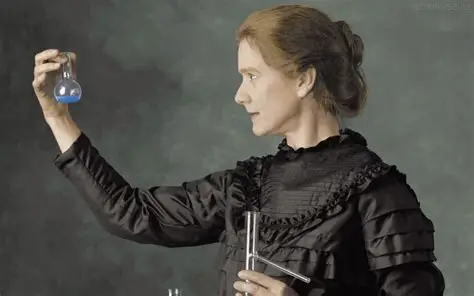
Marie Curie (1867–1934), born Maria Skłodowska in Warsaw, Poland, was a physicist and chemist renowned for her groundbreaking research on radioactivity. She was the first woman to win a Nobel Prize and remains the only person to have received Nobel Prizes in two different sciences: Physics and Chemistry. Curie studied at the Sorbonne in Paris, where she began her lifelong research into radioactive substances alongside her husband, Pierre Curie.
Discovery of Polonium and Radium
Building on the work of Henri Becquerel, Marie Curie and Pierre discovered two new radioactive elements:
- Polonium (Po) — named after her native Poland
- Radium (Ra) — a highly radioactive element with significant medical applications
Curie meticulously measured the properties of these elements, including their emission of radiation, which was critical for understanding atomic structure. The intensity of radioactive emissions was found to be proportional to the amount of the substance present, leading to early quantitative studies of radioactivity.
Scientific Contributions and Methods
Marie Curie developed techniques for isolating radioactive isotopes and performed pioneering work in radiation measurement. The activity of radioactive substances can be expressed mathematically as:
\[ A = \lambda N \]where \( A \) is the activity, \( \lambda \) is the decay constant, and \( N \) is the number of radioactive nuclei. Her work laid the foundation for the fields of nuclear physics and radiochemistry.
Applications and Impact
Curie’s discoveries had profound scientific and medical implications:
- Development of cancer treatment using radiation therapy
- Improvement of medical diagnostic techniques
- Advancement of atomic theory and understanding of radioactive decay
Awards and Legacy
Marie Curie was awarded the Nobel Prize in Physics in 1903 (shared with Pierre Curie and Henri Becquerel) and the Nobel Prize in Chemistry in 1911 for her discovery of radium and polonium. Her dedication, meticulous research, and pioneering spirit inspired generations of scientists, especially women in science. Today, the unit of radioactivity curie (Ci) is named in honor of Marie and Pierre Curie, reflecting her lasting impact on the study of radiation.

All rights reserved by the Mathematical Unity
Contact: +8801400044645
Email: mathematicalhorse1453@gmail.com
Our Discord Server: Mathematical Unity [Ulus Riyadiyat]